Monday, 28 November 2011

Molar Mass

  • The mass (in grams) of 1 mole of a substance is called the molar mass
  • it can be determined from the atomic mass on the periodic table
  • measure in grams over moles (g/mole)
Molar Mass of Compounds
  • to determine the molar mass of a compound add the mass of all the atoms together
Element:
FeO- 55.8=16.0=71.8 g/mol
NO- 14=2(16)= 46.0 g/mol
PCl˅5- 31.0+5(35.5)= 208.5 g/mol
Na˅2SO˅4- 2(23.0)=32.1+4(16.0)= 142.1 g/mol 
H˅2O- 2(1.0)=16.0= 18.0 g/mol 
AlCl˅3- 27.0=3(35.5)= 133.5 g/mol


By: Krysta Del Rosario :D

Tuesday, 22 November 2011

Moles to Volume Conversion

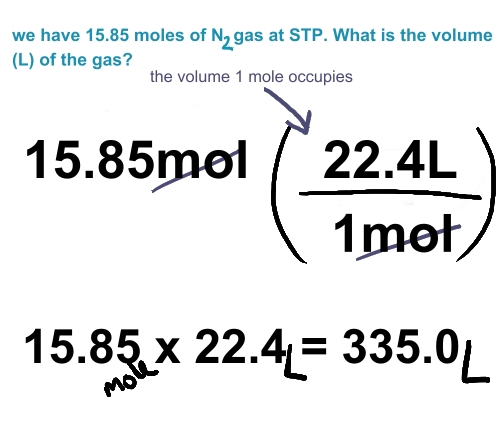
At a specific pressure and temperature, one mole of any gas always have the same volume.
1) At 0 degree C and  101.3 kPa: 1 mol= 22.4 L
- This temperature and pressure is called STp
   - 22.4 L/mol is the molar volume at STP

Example:

How many litres will 4.7 mol of O2 have at STP?

4.5 mol x  22.4 L  = 1.0 x 10^2 litres
                  1 mol


http://www.youtube.com/watch?v=AHqNiEwcXiE

- Candace Chan

Mole Conversions (Converting between grams and moles)

Converting between moles and mass(grams):
1) To convert the units, we use molar mass as the conversion factor. Molar mass is the number of atomic mass added together.
2) Be sure to cancel out the appropriate units.
* remember about the significant digits!
Examples:

How many grams are in 2.5 mol of Cl2?

2.5 mol x   71g      = 1.8 x 10^2 grams
                1 mol
           
How many moles are there in 205g of BeF2?

205g x   1 mol  = 4.36 mol
                47 g


http://www.youtube.com/watch?v=ehepBBtSbDc

-Candace Chan

Monday, 14 November 2011

Avogadro's Number- 6.02 x 10^23

  • Atoms and molecules are extremely small
  • Macroscopic objects contain too many to count or weight individually
  • Amedeo Avogadro proposed that the only number of atoms in 12.00000g of Carbon be equal to a constant (= 1 mol of C)
  • This value is now called Avogadro's number and forms the basis of all quantitative chemistry
  • 1.0 mol= 6.02 x 10^22 atom
  • 1 pair= 2
  • 1 dozen= 12
  • 1 century= 100
  • 1 mol= 6.02 x 10^23
  • One mole represents a huge number of particles
Particle
Atom- element- 6.02 x 10^23/1 mol
Molecule- covalent compound- 6.02 x 10^23/ 1 mol
Formula unit- ionic compound- 6.02 x 10^23/1 mol

Example: 2.47 x 10^25 atoms x 1 mol/ 6.02 x 10^23 atoms = 41 mol


By: Krysta Del Rosario :)

Saturday, 12 November 2011

Hydrate Lab

  The purpose of this experiment is to determine the empirical formula of a hydrate.
               - Hydrates are ionic compounds that contain an inorganic salt compound loosely bound to water.

In this lab, we try to determine the anhydrous (without water) mass of the hydrate.

We had to determine the mass of water by boiling the substance over the bunsen burner and measure the test tube with the substance to find out how much water was in that substance.

We determuine the percent by using the formula:

% Error= measured - accepted    x 100
                       accepted

- Candace and Reo

Thursday, 10 November 2011

Molecular Compounds

·         7 molecules are diatomic

·         2 of the same elements

·         H2, N2, O2, F2, Cl2, Br2, I2

·         2 molecules are polyatomic

·         S8, P4

Naming Molecular Compounds

·         Use the name of the first element

·         Second element ends in-ide

Examples:

N2 O4                         dinitrogen tetraoxide

Cs2                             Carbon disulphide

P4 O10                        tetraphosphorus decaoxide

Nitrogen trichloride          Ncl3

Sulfur dibromide                SBl2

Naming Acids and Bases

·         Hydrogen compounds are acids.

·         HCl(aq) ------------> hydrochloric acid

·         H2SO4(aq) --------------> Sulfuric acid

Acids/Bases to memorize

·         Hydrochloric acid -----------> HCl

·         Nitric Acid -------------> HNO3

·         Sulphuric Acid -----------> H2SO

Example

-HOCCCOOH(aq) ------------------------> C2 O4 (-2)

-Reo

Lewi Dot Diagram

Drawing Electron Dot Diagram:    -the nucleus is represented by the atomic symbol
                                                        -determine the number of valence electrons
                                                        -electrons are represented by dots around the symbol
                                                        -max. electrons each orbital can hold goes 2,8,8...
Example:                                                             Lithium


-in covalent compounds electrons are shared

      Determine the number of valence electron for each atom in the molecule.
      Place atoms so that valence electron are shred to fill each orbital.


-in ionic compounds electrons transfer from one element to another
      Determine the number of valence electrons on each ions
      Put brackets around the metal and non-metal
      Write the charge at the top right of the brackets


-Stanley K.