Wednesday, 18 January 2012

Density and Moles

Density:

- is a measure of mass per volume.
- is measured in g/mL or g/L
- Formula for density is
         

Example:

Oxygen has a density of 1.0 g/ml. Determine the mass of 11.5 mL of oxygen gas.

11.5 mL x 1.0 g      = 11.5 g
                  1 mL

How many moles are there in 11.5 mL of oxygen?

11.5 g x 1 mol   =  0.639 mol
                18 g


http://www.youtube.com/watch?v=REtBibhIqfo


Density of gases:

The density of gases can vary with the temperture.
If the temperature is at STP, we can find density by "

Molar Mass
22.4 L/mol

Example:

32g/mol       = 1.4 g/ L
22.4L/mol

-Candace Chan

Thursday, 1 December 2011

Converting between Moles to Molecules to Atoms

In this conversion, A mole of any substance is 6.02×10²³ molecules of that substance.

To convert moles to atoms, you first convert the mole to molecules then use the element's subscripts and multiply it to the answer.
0.001 moles water × ( 6.02×10²³ water molecules
1 mole water
) = 6.02×10²⁰ water molecules
100 water molecules × ( 1 mole water
6.02×10²³ water molecules
) = 1.66× 10⁻²² moles water


http://www.youtube.com/watch?v=21tLXgeYALc

Monday, 28 November 2011

Molar Mass

  • The mass (in grams) of 1 mole of a substance is called the molar mass
  • it can be determined from the atomic mass on the periodic table
  • measure in grams over moles (g/mole)
Molar Mass of Compounds
  • to determine the molar mass of a compound add the mass of all the atoms together
Element:
FeO- 55.8=16.0=71.8 g/mol
NO- 14=2(16)= 46.0 g/mol
PCl˅5- 31.0+5(35.5)= 208.5 g/mol
Na˅2SO˅4- 2(23.0)=32.1+4(16.0)= 142.1 g/mol 
H˅2O- 2(1.0)=16.0= 18.0 g/mol 
AlCl˅3- 27.0=3(35.5)= 133.5 g/mol


By: Krysta Del Rosario :D

Tuesday, 22 November 2011

Moles to Volume Conversion

At a specific pressure and temperature, one mole of any gas always have the same volume.
1) At 0 degree C and  101.3 kPa: 1 mol= 22.4 L
- This temperature and pressure is called STp
   - 22.4 L/mol is the molar volume at STP

Example:

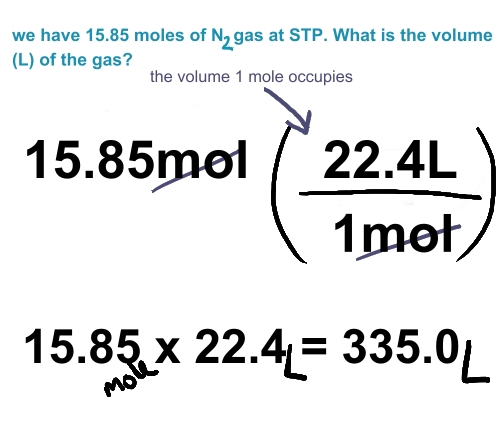
How many litres will 4.7 mol of O2 have at STP?

4.5 mol x  22.4 L  = 1.0 x 10^2 litres
                  1 mol


http://www.youtube.com/watch?v=AHqNiEwcXiE

- Candace Chan

Mole Conversions (Converting between grams and moles)

Converting between moles and mass(grams):
1) To convert the units, we use molar mass as the conversion factor. Molar mass is the number of atomic mass added together.
2) Be sure to cancel out the appropriate units.
* remember about the significant digits!
Examples:

How many grams are in 2.5 mol of Cl2?

2.5 mol x   71g      = 1.8 x 10^2 grams
                1 mol
           
How many moles are there in 205g of BeF2?

205g x   1 mol  = 4.36 mol
                47 g


http://www.youtube.com/watch?v=ehepBBtSbDc

-Candace Chan

Monday, 14 November 2011

Avogadro's Number- 6.02 x 10^23

  • Atoms and molecules are extremely small
  • Macroscopic objects contain too many to count or weight individually
  • Amedeo Avogadro proposed that the only number of atoms in 12.00000g of Carbon be equal to a constant (= 1 mol of C)
  • This value is now called Avogadro's number and forms the basis of all quantitative chemistry
  • 1.0 mol= 6.02 x 10^22 atom
  • 1 pair= 2
  • 1 dozen= 12
  • 1 century= 100
  • 1 mol= 6.02 x 10^23
  • One mole represents a huge number of particles
Particle
Atom- element- 6.02 x 10^23/1 mol
Molecule- covalent compound- 6.02 x 10^23/ 1 mol
Formula unit- ionic compound- 6.02 x 10^23/1 mol

Example: 2.47 x 10^25 atoms x 1 mol/ 6.02 x 10^23 atoms = 41 mol


By: Krysta Del Rosario :)

Saturday, 12 November 2011

Hydrate Lab

  The purpose of this experiment is to determine the empirical formula of a hydrate.
               - Hydrates are ionic compounds that contain an inorganic salt compound loosely bound to water.

In this lab, we try to determine the anhydrous (without water) mass of the hydrate.

We had to determine the mass of water by boiling the substance over the bunsen burner and measure the test tube with the substance to find out how much water was in that substance.

We determuine the percent by using the formula:

% Error= measured - accepted    x 100
                       accepted

- Candace and Reo